

Specialized Vision Care
Vision plays a fundamental role in their development, learning, and overall well-being as you child grows. Our Specialized Vision Care services are dedicated to the early detection and evidence-based management of critical childhood vision conditions like Myopia (Nearsightedness) and Amblyopia (Lazy Eye).

Myopia Management (Nearsightedness)
Slowing Nearsightedness in Children with Safe, Proven Treatments
Myopia, or nearsightedness, is a common vision condition where distant objects appear blurry. It typically develops in childhood and tends to worsen with age, often requiring stronger prescription changes each year. At Streamline Optometric, our eye doctor offers evidence-based myopia control to slow progression and help protect your child’s long-term eye health.
Why Is Myopia Control Important?
Unchecked, progressive myopia can increase the risk of serious eye diseases later in life, including:
-
Retinal detachment
-
Glaucoma (eye conditions that damages the optic nerve)
-
Cataracts (clouding of the lens)
-
Macular degeneration (damage to the central part of the retina)

Signs of Myopia (Nearsightedness)
Myopia makes distant objects blurry, causing your child to compensate with certain behaviors.
-
Frequent Squinting or Frowning: They may narrow their eyes to temporarily improve the clarity of distant objects.
-
Sitting Too Close: Consistently sitting very close to the TV, holding a book or tablet close to the face, or needing to be at the front of the classroom.
-
Complaints of Blurry Distance Vision: Directly stating that things far away (like signs, the board, or movie screens) look fuzzy.
-
Eye Strain and Headaches: Complaints of headaches, especially late in the day or after focusing on distant objects.
-
Lack of Interest in Distant Activities: Avoiding sports or activities that require clear distance vision (e.g., catching a ball, playing outdoors).
Myopia Control Treatment Options
We offer safe, child-friendly treatments that are effective in slowing the progression of myopia:
-
Low-Dose Atropine Eye Drops: A simple, daily eye drop that’s clinically proven to slow myopia progression with minimal side effects.
-
MiSight® Contact Lenses: FDA-approved daily disposable lenses designed specifically for children to correct vision and slow axial elongation.
-
Multifocal Contact Lenses: Soft lenses that offer both vision correction and myopia control.
-
Multifocal Glasses: For children who prefer glasses over contact lenses, multifocal lenses can help reduce focusing stress and slow myopia progression.

Amblyopia Management (Lazy Eye)
Strengthening the Brain-Eye Connection to Prevent Permanent Vision Loss
Amblyopia, commonly known as "lazy eye," is a condition where vision in one eye is reduced because the eye and the brain aren't working together correctly. It develops when the brain favors one eye over the other, causing the nerve pathway from the weaker eye to the brain to not develop properly in early childhood.
Early detection and management are critical because the visual system is most responsive to treatment during a child’s developmental years (usually before age 7-10).
Why Is Amblyopia Management Important?
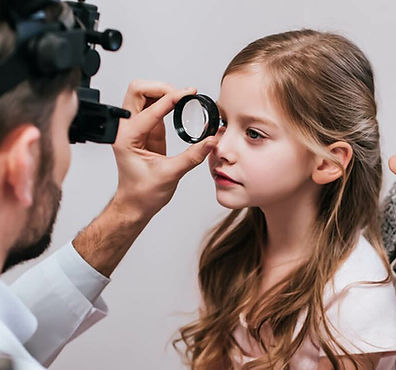
If left untreated, amblyopia can lead to permanent vision loss in the affected eye, even if the underlying eye problem is corrected later in life. Long-term risks include:
-
Permanent reduced vision in the weaker eye.
-
Poor depth perception (stereopsis), which can affect sports, driving, and daily tasks.
-
Increased risk of significant vision impairment if the stronger eye is ever injured or affected by disease.
Signs of Amblyopia
Amblyopia is a developmental issue where the brain favors one eye. Look for physical signs and issues with depth perception:
-
Eye Wandering or Crossing (Strabismus): One eye visibly drifts inward, outward, upward, or downward, especially when the child is tired or daydreaming.
-
Squinting or Shutting ONE Eye: Covering or closing only one eye, particularly in bright light or when focusing intently on a task.
-
Poor Depth Perception: Difficulty judging distances, leading to the child being accident-prone, frequently tripping, falling, or struggling to catch a ball.
-
Persistent Head Tilting: Consistently tilting the head to one side to use the dominant eye and avoid the weaker eye.
-
Reading Difficulties: Losing their place while reading, skipping words, or having trouble completing schoolwork that requires fine visual attention.
Amblyopia Control Treatment Options
The goal of amblyopia management is to train the brain to use the weaker eye, strengthening the connection between the eye and the visual centers of the brain. Treatment depends on the underlying cause and may include:
-
Corrective Eyewear: Glasses or contact lenses are often the first step to correct underlying refractive errors (nearsightedness, farsightedness, or astigmatism) that cause the blurred vision contributing to amblyopia.
-
Occlusion Therapy (Eye Patching): The child wears an adhesive patch over the stronger eye for a prescribed number of hours each day. This forces the brain to rely on and strengthen the vision in the weaker, amblyopic eye.
-
Atropine Eye Drops: Medicated drops are applied to the stronger eye to temporarily blur its vision. This method, called penalization, is an alternative to patching that encourages the brain to use the weaker eye.
-
Vision Therapy/Digital Therapies: Specialized visual exercises or newer digital programs (sometimes involving virtual reality) are used to train both eyes to work together and improve the connection to the brain.
-
Surgery: Surgery may be recommended to correct underlying issues like a cataract, a droopy eyelid, or significant eye misalignment (strabismus).
Schedule an Online Consultation Today!
Protect your child’s vision early and learn which treatment and management plan is best for your child's unique needs. Book a specialized vision care evaluation with our doctors at Streamline Optometric in Yelm, WA. Consultations are conducted virtually through Zoom and Google Meet for your convenience.